

Chairs in rows. A clock on the wall. A script we didn’t write.
We were told this was participation. That showing up every few years, casting a vote, or filling out a form was the shape of power. That if we followed the process, if we made ourselves legible, the system would respond.
But over time, in too many rooms, at too many long tables with too little consequence, it became clear that something else was happening. That the structures built to distribute power were also gatekeeping it. That the rituals of inclusion didn’t necessarily lead to change.
What was offered to us wasn’t really democracy.
It was proximity.
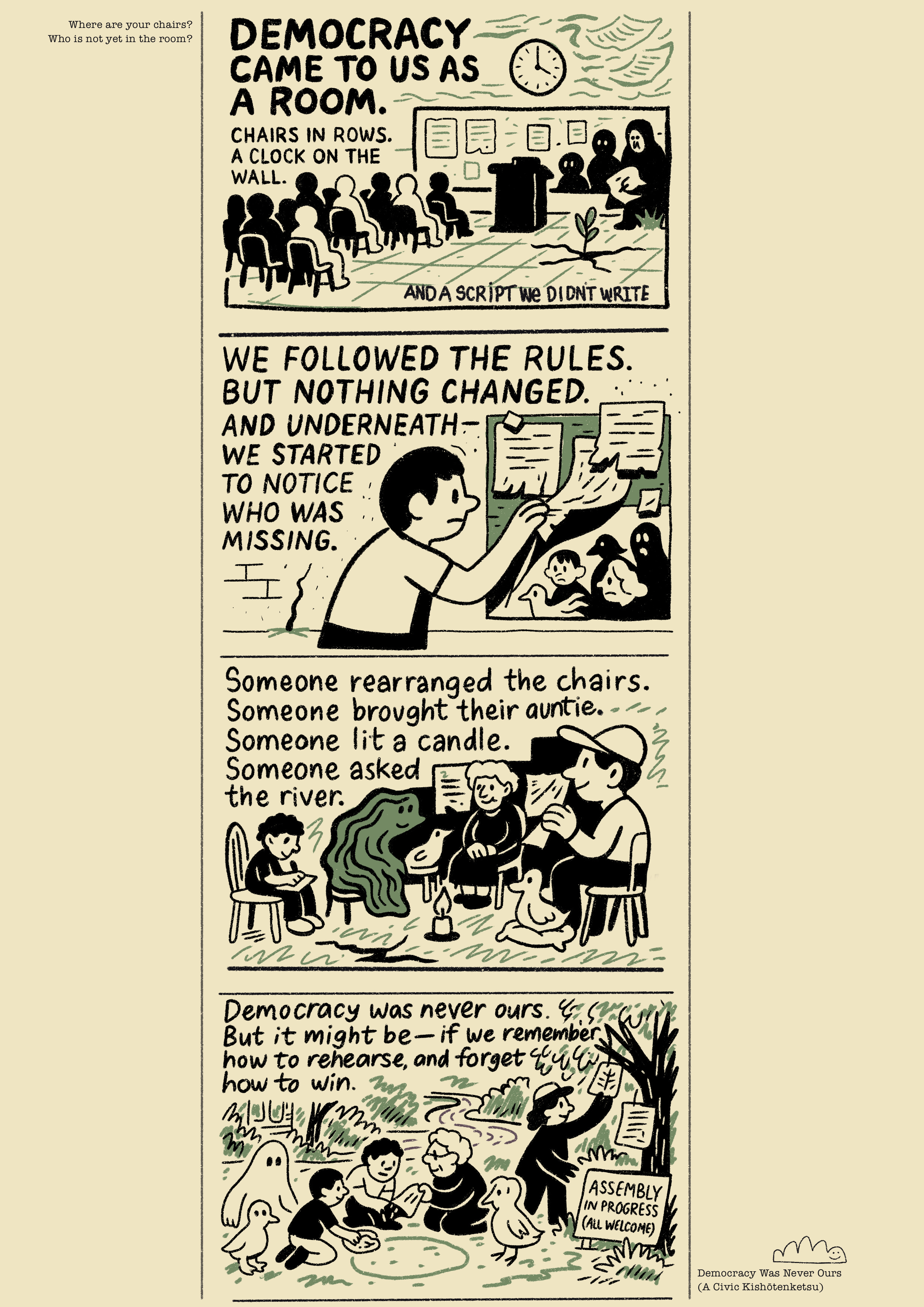
The Inherited Frame
Most democratic institutions were designed for a world that no longer exists. Built for delegation, stability, and order, they rely on fixed cycles, abstracted authority, and an architecture of participation that rewards compliance.
We are told these systems are neutral. That process ensures fairness. That if we engage correctly, outcomes will follow.
But power is never neutral. And process, as many have come to realise, can become performance.
Consultation becomes ritual. Voting becomes theatre. Participation is welcomed only on terms already decided. Legitimacy is earned not by what you build, but by how well you navigate the machinery.
These are not flaws in the system. They are the system. They are how it sustains itself — through appearance, not relation.
And as crisis compounds crisis, the gap between democratic form and civic reality continues to widen.
Refusal as Design
For some, the response is to reform the frame. To improve policy. Upgrade platforms. Optimise engagement.
But for many, the response has been something quieter. Slower. More fundamental.
Refusal.
Not refusal as withdrawal, but as design. As a reorientation of how power moves, who holds it, and where governance begins.
Refusal as slowness in a system that accelerates. As messiness in a system that demands clarity. As a way of saying: if this process cannot hold our grief, our bodies, our difference. We will find another.
This is not a rejection of democracy. It is a commitment to something deeper.
To governance that begins in relation, not structure. To agency that doesn’t need permission.
Other Rooms
In Mexico City, Sunday cyclists have, over time, transformed protest into policy. The city didn’t plan this, it adapted. Because people kept riding. Kept gathering. Kept showing up in patterns that demanded recognition. Infrastructure followed rhythm. Regulation followed relation.
Elsewhere, in Boorloo, the Town Team Movement began with local care and grew into a distributed network of civic stewards. Residents didn’t wait for council mandates. They set up tables in the street, created new trusts, and started making decisions about the spaces they lived in.
What these examples share isn’t a model. It’s a memory. A memory of democracy as something embodied and iterative. A governance not of forms, but of gestures repeated until they hold.
They suggest that the future of democracy might not lie in institutional reform, but in civic rehearsal.
Not perfection.
Return.
The Loop Over the Line
Many of the systems we rely on assume that governance moves linearly. Problem, solution. Agenda, outcome. Motion, resolution.
But the realities we face, ecological collapse, economic instability, social fragmentation, do not resolve. They entangle.
And so governance must shift from linearity to recursion. From decision-as-conclusion to decision-as-continuation.
What matters is not whether we agree, but whether we can stay in the room. Whether we can return.
A different rhythm begins to emerge:
Affirm what matters
Object where harm appears
Integrate what can be held
Negate what must be shed
Contextualise what remains
Then loop again. And again.
This is not indecision. It is maturity.
It is governance that refuses to simplify what should be held in complexity.
Composting the Inherited
There’s an image I keep returning to. A single plant pushing through a crack in a tiled floor.
This, to me, is what composting looks like.
Not collapse. Not revolution. But slow decomposition of the forms that no longer serve. Old charters. Extractive platforms. Participation that extracts without listening.
We don’t need to burn it all down. We need to let it rot, with care.
Because composting is not chaos. It is time-aware design. It is how living systems make room for what’s next.
What Holds
What replaces the hollow rituals of inherited democracy won’t arrive all at once. There will be no blueprint.
Instead, we will find fragments. Rhythms. Patterns already underway.
Some will be tiny. A neighbourhood that decides together when to open a library. A mutual aid network that co-creates its own protocols. A public space reconfigured not for efficiency, but for presence.
Others will be harder to name. A gathering that holds disagreement without rupture. A group that pauses a decision because the land they meet on feels tired. A governance tool that begins with breath, not metrics.
These are not gestures of resistance. They are strategies of re-organisation.
They signal a shift: from governance as control to governance as relation.
The Tangle Is the Terrain
In many policy circles, there remains a strong desire for clarity. For scalable models. For consensus.
But real governance is not tidy.
It contradicts itself. It mourns and builds simultaneously.
It loops. It pauses. It frays.
Power rarely moves in straight lines. It flows through bodies, landscapes, inheritance, trauma. Through what is unsaid. Through what doesn’t translate.
To govern otherwise is to accept that democracy does not mean uniformity. It means staying. In the tangle. In the threshold. In the space between.
The Assembly in Progress
There is no podium in the final scene. No speech. No outcome.
Just a folding table in a public space. Chairs made of crates. People and ghosts and birds and trees. A hand-painted sign that reads: Assembly in Progress (All Welcome).
It looks like nothing. But it may be everything.
Because governance is not a theory. It is a rehearsal. A decision to stay in the room. A commitment to loop. A willingness to let the table grow legs.
This is where democracy lives now. Not in chambers. Not in checkboxes. But in circles. In compost. In the questions we return to.
What if the next great democratic project isn’t institutional reform, but civic rehearsal?
Not for perfection. But for return.