

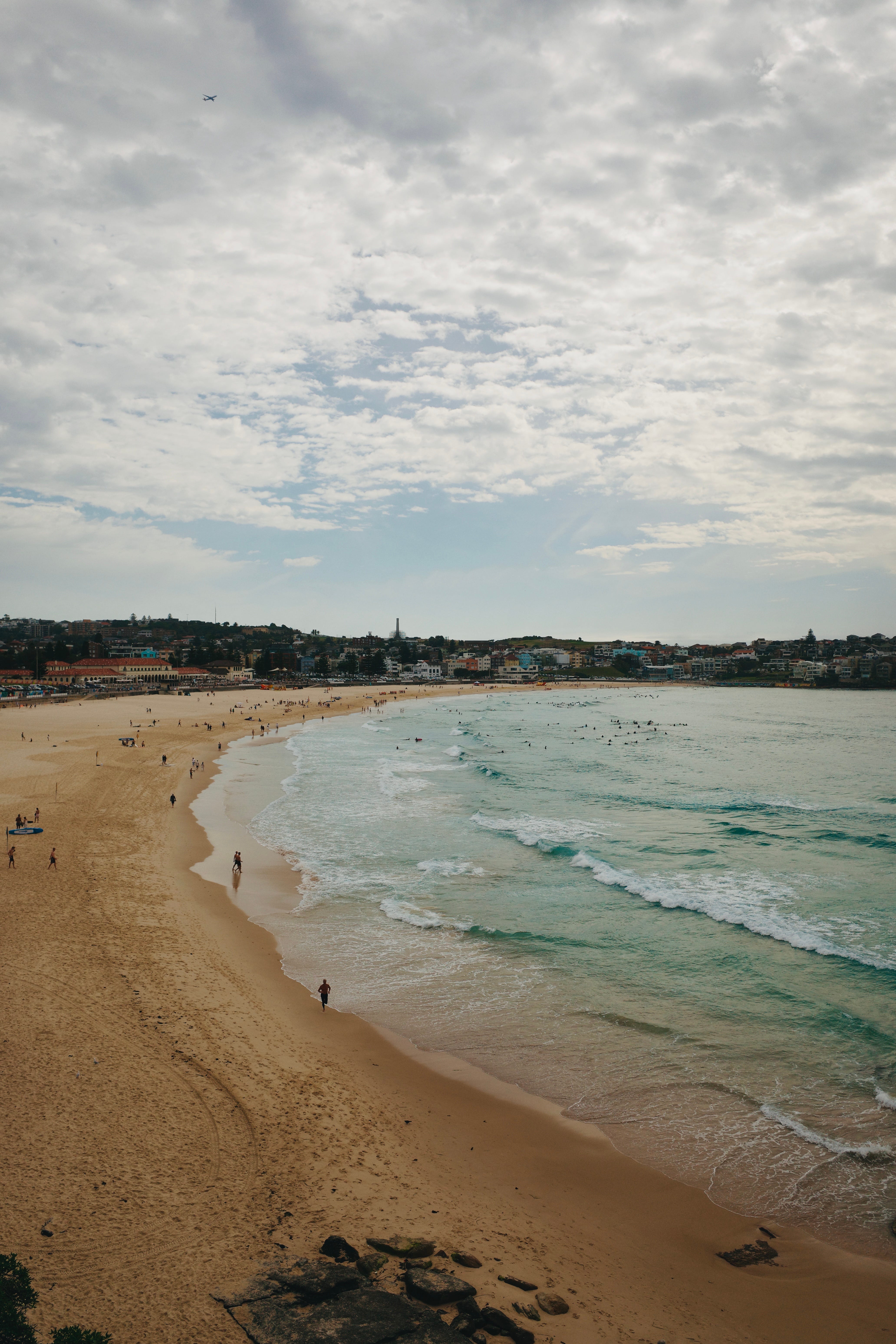
I took this photo on a morning when the light felt unsettled. The sky dragging its weight low across the water. The beach already alive with scattered bodies. People walking the long curve of sand like they were rehearsing some old choreography they had almost forgotten. The tide folding itself in slow repetitions as if demonstrating the art of beginning again.
Lately I have been thinking about change the way I think about shorelines. Nothing breaks all at once. Nothing stays fixed. We talk about transformation like it is a clean pivot, a decision shaped in a meeting room. But the truth is quieter. It begins in the undercurrents. In the friction of small gestures. In the unnoticed work that shifts a coastline grain by grain until one day you realise the land has a different shape.
Standing here, watching the water drag and release, I kept noticing tiny acts of repair. Someone picking up litter left behind by the night. A stranger helping another steady their board in the whitewash. A couple lingering longer than they needed to, watching the waves as if listening for instruction. None of these are dramatic. Yet this is the scale where real civic change starts. Not in declarations. In practice.
We are living in a time where the old anchors have slipped. Certainty has thinned. The maps we inherited no longer match the world under our feet. We keep trying to navigate with tools built for a calmer century, and wonder why everything feels unstable. But maybe the instability is not the problem. Maybe it is the signal.
Because the world is asking something of us. Asking us to move from control to conditions. From prediction to attention. From isolation to interdependence. To read the tide rather than attempt to freeze it. To understand that the future is not a place we reach. It is something we shape through the way we meet each moment.
And here is the burning platform: the tide is already shifting. Faster than our institutions. Faster than our habits. Faster than our excuses. If we do not act, the coastline will redraw itself without us. Not metaphorically. Literally. Socially. Politically. Ecologically.
The most dangerous thing we can do now is pretend we have time.
What gives me hope is that the beginnings of a different future are already visible. In the way people pause to help a stranger. In the rising language of care. In the small refusals to look away. In communities learning how to build their own forms of resilience when systems lag behind. These are not soft gestures. They are structural. Tidal. Capable of accumulating into something that can shift a city.
If there is a movement here, it is not loud. It does not need permission. It grows through porousness. Through the willingness to let ourselves be moved rather than tightened. Through the simple refusal to be numb in a moment that relies on our numbness to survive.
This photo is just a beach. A curve of sand. A restless sky. A morning like any other. Yet it reminds me that the future arrives exactly this way. First as a brush against your ankles. Then as a tug. Then as a force. And we can either prepare together or be carried somewhere we did not choose.
Pay attention to the places where care already lives. Strengthen them. Name them. Grow them. Let your smallest gestures shift the current. Let your presence become a condition for change rather than a witness to its absence.